



Restaurant Tax Credit Tips: FICA Tip Credit & How To Claim
If you own or operate a restaurant, you're already dealing with thin margins, rising costs, and a workforce that depends heavily on tipped income. What many restaurant owners don't realize is that the tips your employees earn can actually put money back in your pocket at tax time. Understanding restaurant tax credit tips, particularly the FICA tip credit, can mean thousands of dollars in annual tax savings that go unclaimed simply because business owners don't know they qualify.
The FICA tip credit, formally known as the Section 45B credit, allows eligible employers to claim a federal tax credit based on the employer-paid portion of FICA taxes on employee tips that exceed the federal minimum wage. It's one of the most overlooked credits in the food service industry, and calculating it correctly requires attention to detail. Beyond the tip credit, restaurant owners also have access to a range of deductions and credits, from the Work Opportunity Tax Credit to equipment depreciation, that can significantly reduce their overall tax burden.
At TaxesToday, our licensed and certified tax professionals work directly with small business owners, including restaurant operators, to identify every credit and deduction available under current tax law. With over 15 years of experience preparing taxes for self-employed individuals, LLCs, and S-Corps, we handle the complexity so you don't leave money on the table. This article breaks down exactly how the FICA tip credit works, how to calculate and claim it, and what other tax strategies restaurant owners should have on their radar for the 2026 filing season.
What the FICA tip credit is and who qualifies
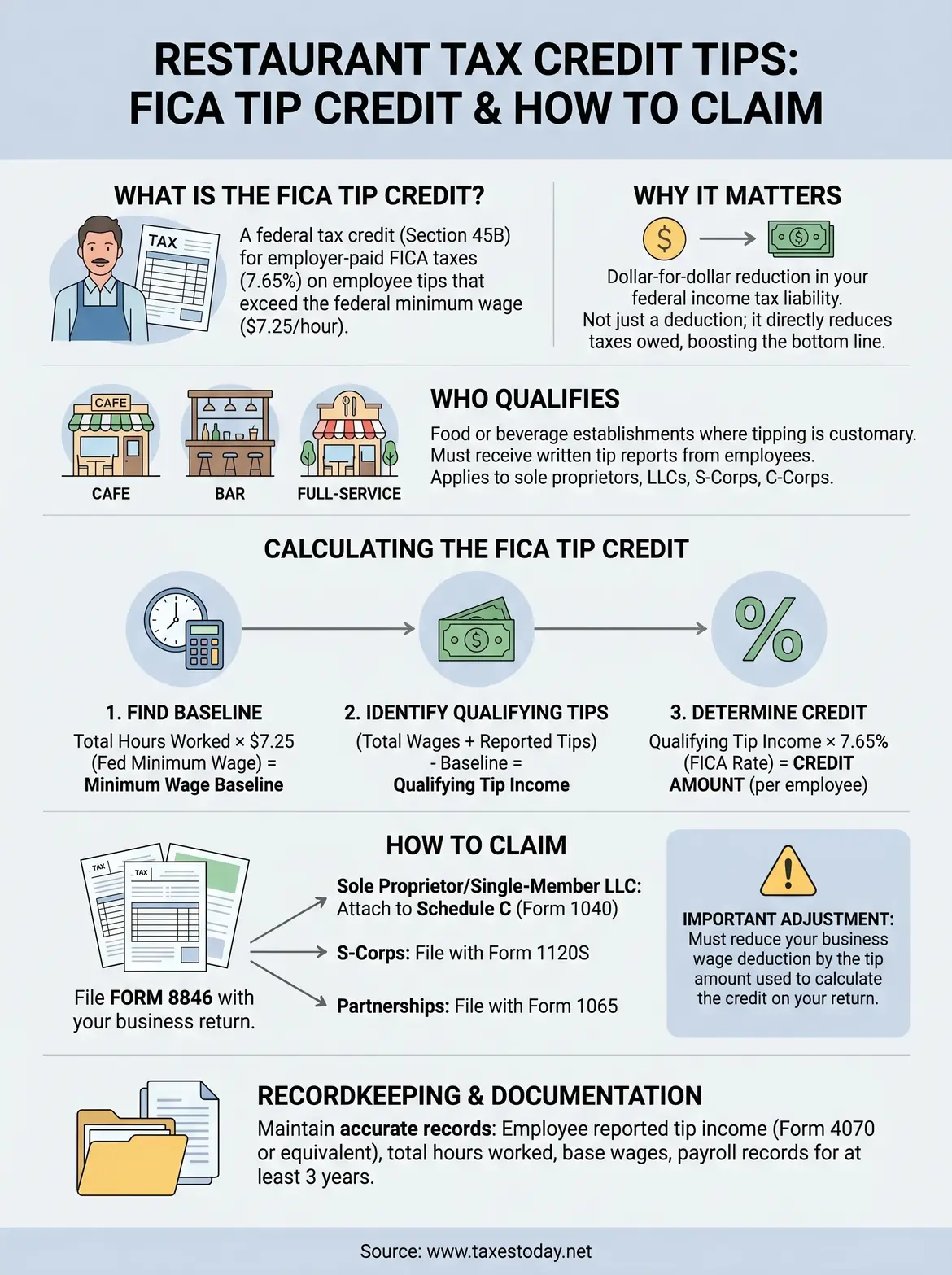
The FICA tip credit is a federal tax credit established under Section 45B of the Internal Revenue Code. As an employer, you pay your share of FICA taxes (Social Security and Medicare) on all wages, including tips your employees report to you. When those tips push an employee's total compensation above the federal minimum wage of $7.25 per hour, you can claim a credit for the FICA taxes you paid on that excess tip amount. That credit directly reduces your federal income tax liability dollar-for-dollar.
The FICA tip credit is one of the most valuable restaurant tax credit tips available because it turns a mandatory payroll tax expense into a direct offset against what you owe the IRS.
The legal basis for the credit
Section 45B was specifically designed to offset the burden employers carry when employees earn tips. The IRS defines tips as discretionary payments made by customers directly to employees. Because you are required to withhold and pay FICA taxes on all reported tips, Congress created this credit to partially reimburse employers for that mandatory cost. The credit rate equals the employer's share of FICA taxes, which is 7.65% (6.2% Social Security plus 1.45% Medicare), applied to qualifying tip income above the federal minimum wage threshold.
Employer eligibility requirements
You qualify for the FICA tip credit if you operate a food or beverage establishment where tipping is a normal, customary practice. This includes full-service restaurants, bars, cafes, and similar businesses where customers regularly leave tips for service. Your business structure does not affect your eligibility. Whether you operate as a sole proprietor, single-member LLC, S-Corp, or C-Corp, you can claim the credit as long as your employees receive and report tips through your payroll system.
To be eligible, you need to confirm that your employees:
- Report their tips to you in writing, since unreported tips do not count toward the credit
- Work in a tipping-customary environment where customers voluntarily leave gratuities
- Have their full wages and tip income accurately tracked through payroll records for the entire tax year
Why this credit matters for restaurant owners
Restaurant profit margins typically run between 3% and 9%, which means every dollar you save on taxes directly improves your bottom line. The FICA tip credit is not a deduction that reduces your taxable income; it is a dollar-for-dollar reduction in your federal tax bill. For a restaurant owner with a team of tipped employees, this credit can easily reach $10,000 or more in a single tax year, depending on your headcount and tip volume.
A tax deduction reduces the income you're taxed on, but a tax credit reduces the actual tax you owe, making credits far more powerful for reducing your total liability.
The dollar impact on your bottom line
Consider a restaurant with ten servers, each earning $15,000 in reported tips annually. After subtracting the federal minimum wage threshold for hours worked, a meaningful portion of those tips qualifies for the 7.65% FICA credit rate. Across your entire staff, that calculation adds up to a substantial credit that most restaurant owners simply leave unclaimed each year.
When you stack the FICA tip credit alongside other restaurant tax credit tips like equipment depreciation and the Work Opportunity Tax Credit, your total tax savings grow considerably. Pursuing every available credit each year is one of the most direct ways to strengthen your restaurant's cash position without cutting costs elsewhere.
How to calculate the FICA tip credit
The calculation follows a straightforward formula, but you need accurate payroll records and a clear understanding of the federal minimum wage threshold before you start. The IRS bases the credit on tips that push total employee compensation above $7.25 per hour, not on every tip your employees receive.
The step-by-step formula
To calculate your credit for each tipped employee, follow these three steps:
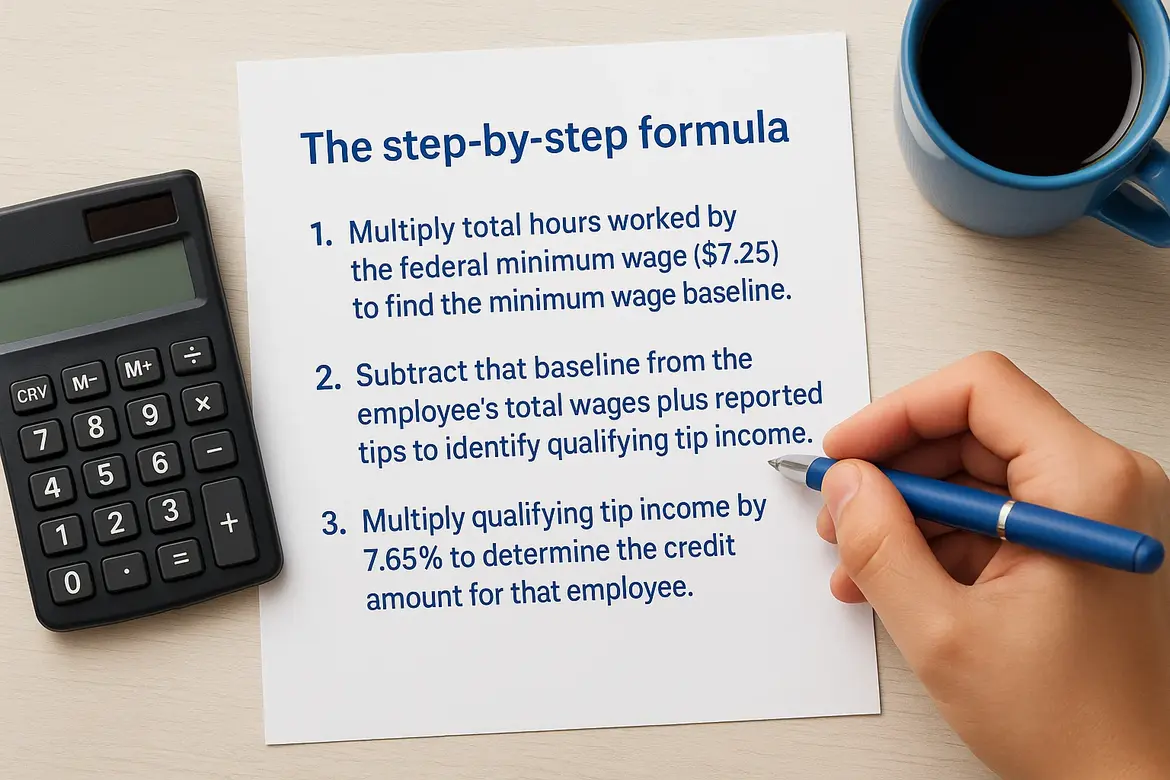
- Multiply total hours worked by the federal minimum wage ($7.25) to find the minimum wage baseline.
- Subtract that baseline from the employee's total wages plus reported tips to identify qualifying tip income.
- Multiply qualifying tip income by 7.65% to determine the credit amount for that employee.
Add each employee's result together to get your total FICA tip credit for the year.
Running this calculation individually for every tipped employee gives you the most accurate credit amount and keeps your filing fully IRS-compliant.
A practical example
Say one of your servers worked 2,000 hours and reported $18,000 in tips on top of a $5,000 base wage. The minimum wage baseline is $14,500 (2,000 x $7.25). Total compensation is $23,000, so qualifying tip income is $8,500. Multiply $8,500 by 7.65% and you get a $650.25 credit for that one employee. Applying this process across your full staff is one of the most reliable restaurant tax credit tips you can act on each filing season.
How to claim the credit on your tax return
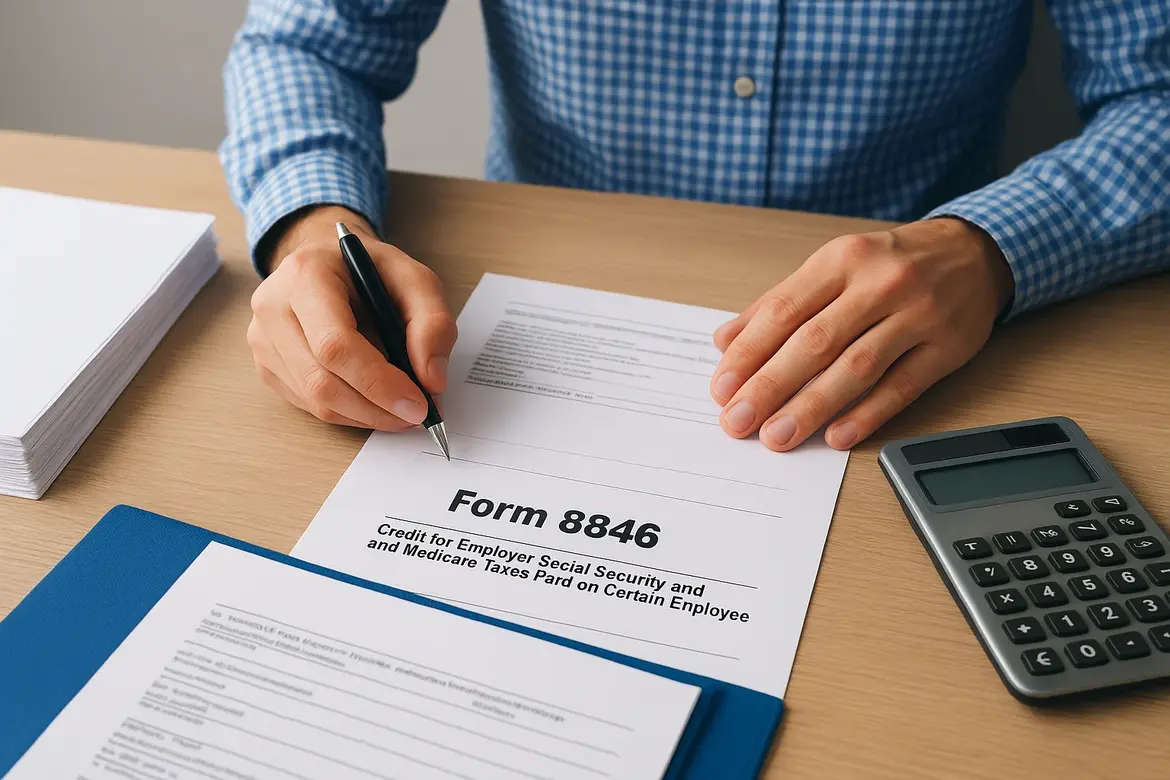
Claiming the FICA tip credit requires you to file Form 8846 with your federal tax return. This form, titled Credit for Employer Social Security and Medicare Taxes Paid on Certain Employee Tips, is where you document the calculation you built from your payroll records. Without this form attached to your return, you cannot receive the credit, regardless of how accurately you performed the underlying math.
Filing Form 8846 with your business return
You attach Form 8846 directly to your business tax return. The form you use depends on your business structure:
- Sole proprietors and single-member LLCs: Attach to Schedule C on Form 1040
- S-Corps: File with Form 1120S
- Partnerships: File with Form 1065
The total credit amount from Form 8846 then carries to the appropriate credit line on your return, reducing what you owe dollar-for-dollar.
How pass-through entities handle the credit
If you operate as a pass-through entity, the credit flows from your business return to your personal Form 1040 via Schedule 3, line 6b. One critical adjustment: the IRS requires you to reduce your wage deduction by the amount of tips used to calculate the credit. You cannot deduct and credit the same payroll dollars.
Getting this adjustment right from the start keeps your return accurate and prevents IRS correspondence down the line.
Applying these restaurant tax credit tips correctly ensures your filing is clean and your credit is fully supported by documentation.
Recordkeeping and common mistakes to avoid
Strong recordkeeping is the foundation of every restaurant tax credit tips strategy. Without organized documentation, even a correctly calculated FICA tip credit can fall apart under IRS scrutiny. You need to maintain payroll records and tip reports throughout the year, not just at filing time.
Records you need to keep
Your records must show each employee's reported tip income alongside their total hours worked and base wages for every pay period. The IRS requires employees to report tips using Form 4070 or a written equivalent, and you must retain those reports as part of your business records. Keep these documents for at least three years from the filing date of the return on which you claimed the credit.
Losing or failing to collect tip reports during the year is the single fastest way to disqualify an otherwise valid credit claim.
Mistakes that cost you the credit
One of the most common errors is failing to reduce your wage deduction on your return by the amount of tips used in the Form 8846 calculation. Skipping that adjustment creates an inconsistency the IRS will flag. Another frequent mistake is including unreported tips in your credit calculation. Only tips your employees formally reported to you qualify, so tips that bypassed your payroll records cannot be counted toward the credit.
Next steps
The FICA tip credit is one of the most actionable restaurant tax credit tips available to food service business owners, but only if you file Form 8846 correctly, maintain complete payroll and tip records throughout the year, and apply the wage deduction adjustment without skipping steps. Every piece of this process builds on accurate documentation, so the work you do during the year directly determines the credit you collect at filing time.
Starting now gives you the advantage heading into the next filing season. Review your current payroll system to confirm you are collecting written tip reports from every tipped employee each pay period. If your records have gaps or your prior returns did not include Form 8846, those are problems worth correcting before they compound. The team at TaxesToday handles business and self-employed tax returns for restaurant owners who want accurate filings and every credit they are entitled to claim.