


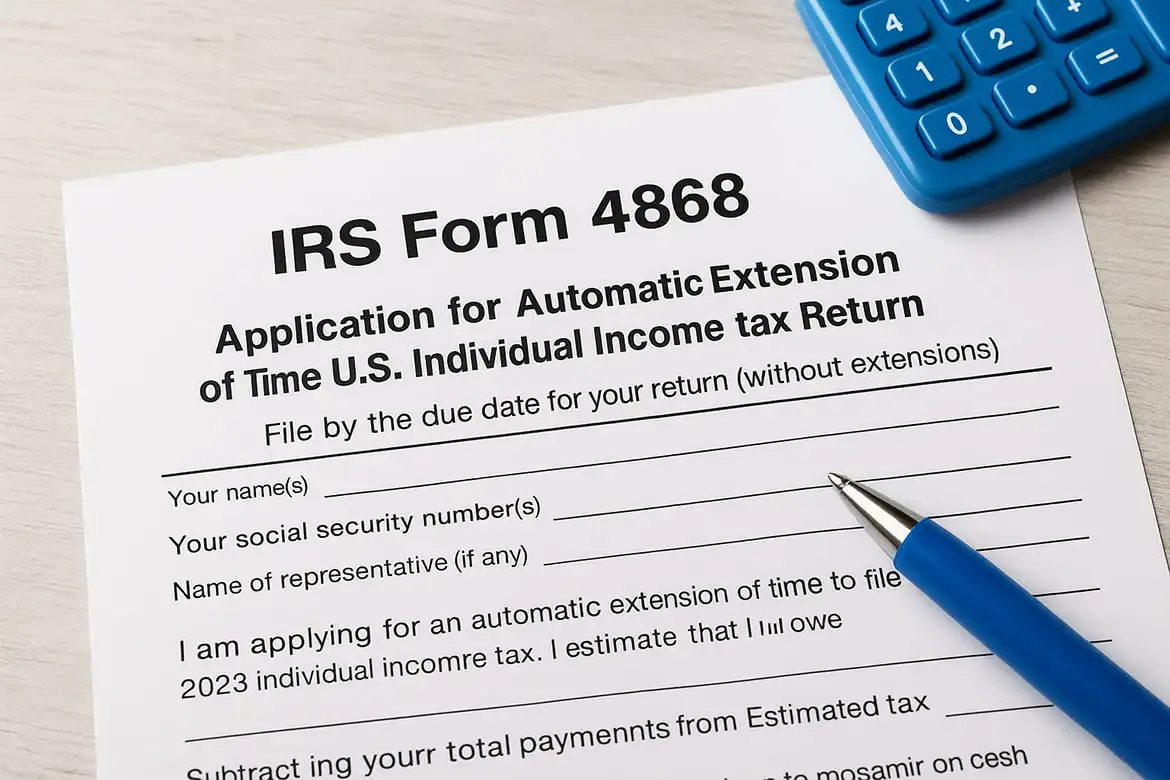
IRS Form 4868 Instructions: How To File A Tax Extension
Filing your federal income tax return by the April deadline isn't always realistic. Life gets complicated, maybe you're waiting on a K-1, sorting out self-employment income, or simply need more time to get your documents together. Whatever the reason, the IRS gives you a straightforward option: IRS Form 4868 instructions walk you through requesting an automatic six-month extension to file your individual tax return, pushing your deadline to October 15.
But here's where people trip up. An extension to file is not an extension to pay. If you owe taxes, you're still expected to estimate and send payment by the original April deadline, otherwise, interest and penalties start adding up. Understanding exactly how to complete Form 4868, when to submit it, and what happens after you do can save you from costly mistakes that are entirely avoidable.
In this guide, we break down the full process step by step, from filling out each line of the form to choosing between e-filing and mailing a paper copy. At TaxesToday, our CTEC-certified and IRS-registered tax preparers handle extension filings and complex tax situations every day, so we built this guide based on what we actually see clients get wrong. Whether you're filing on your own or want a professional to handle it, you'll walk away knowing exactly how to file Form 4868 the right way.
What Form 4868 does and does not do
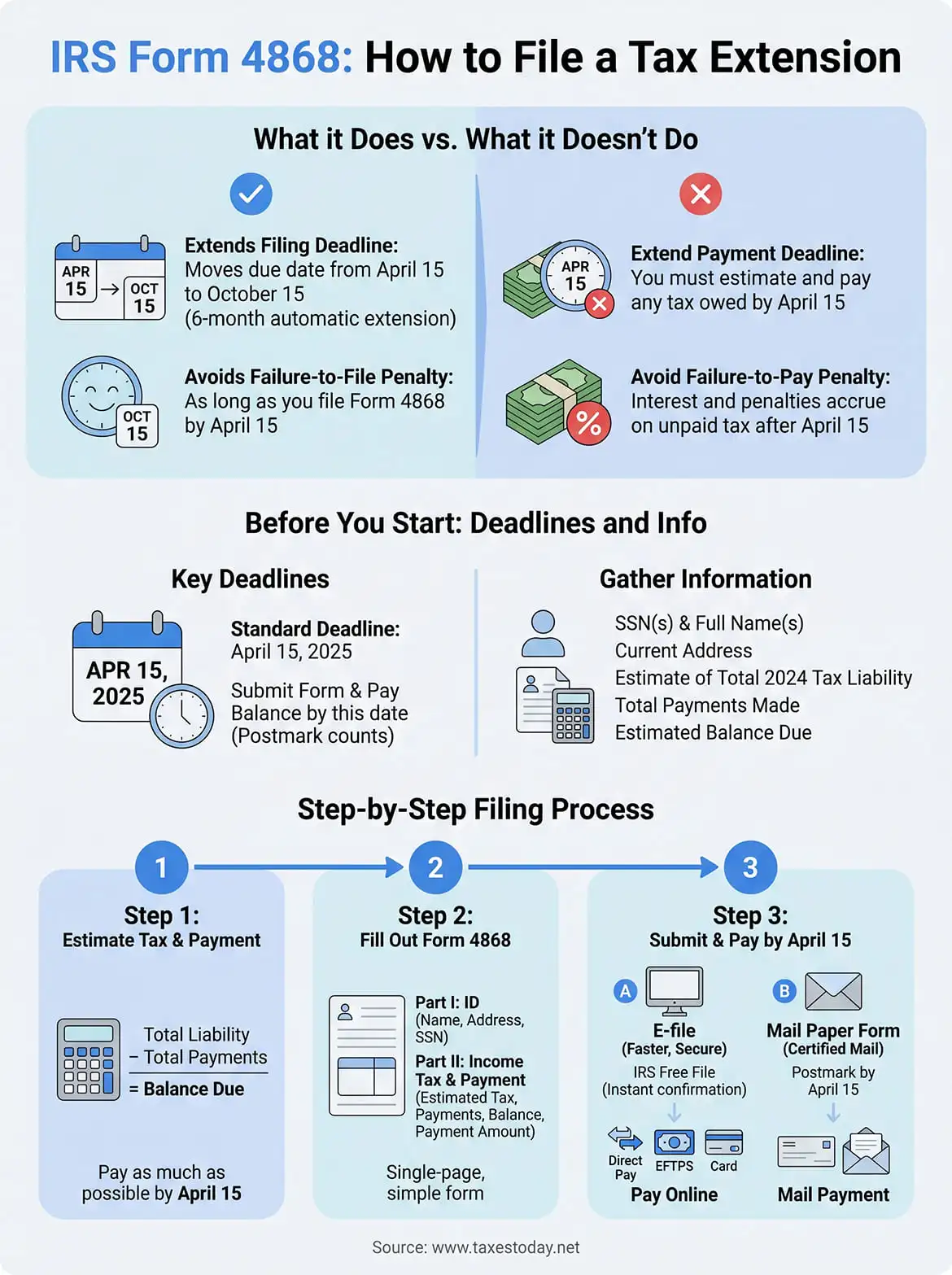
Form 4868 is a one-page IRS form that grants you an automatic six-month extension to file your federal individual income tax return. When you submit it correctly and on time, you push your filing deadline from April 15 to October 15 without needing to provide any reason or justification to the IRS. No approval is required. As long as you file the form before the original deadline, the extension is automatically granted.
What the extension actually gives you
Following the irs form 4868 instructions correctly gives you extra time to gather documents, work through complicated tax situations, or simply avoid rushing a return that could contain errors. This matters most if you are waiting on Schedule K-1 forms from partnerships or S-corporations, which often arrive late in the tax season. Here is a clear summary of what the extension covers:
- Extra time to file: Moves your filing deadline from April 15 to October 15
- No failure-to-file penalty: As long as you file by October 15, the IRS will not charge you a late filing penalty on top of any balance owed
- Broad eligibility: Covers Form 1040, 1040-SR, and 1040-NR filers
Filing an extension removes the failure-to-file penalty, which is typically 5% of unpaid taxes per month, up to 25% of the total balance owed.
What the extension does not cover
Here is where many filers make a costly mistake. Form 4868 does not extend your deadline to pay any taxes you owe. Your payment is still due by April 15, regardless of whether you file the extension. If you owe money and do not pay by that date, the IRS will charge a failure-to-pay penalty of 0.5% per month plus daily interest on the unpaid balance.

Your extension also does not cover state income tax returns. Most states have their own extension process, and some require a separate form. California, for example, automatically grants a six-month extension to file, but you still need to pay at least 90% of your state tax liability by the original due date to avoid state penalties. Always check your state's rules separately so you are not caught off guard when you finally sit down to file.
Before you start: deadlines and info to gather
Before you touch the form, get clear on the key dates and pull together the information you need to complete it accurately. Skipping this step is what causes errors, and an error on Form 4868 can mean an invalid extension request.
Key deadlines to know
The standard deadline to submit Form 4868 is April 15. If April 15 falls on a weekend or federal holiday, the deadline shifts to the next business day. For the 2024 tax year (returns due in 2025), the deadline is April 15, 2025. Members of the U.S. military serving abroad and certain U.S. citizens living outside the country may qualify for automatic deadline extensions without filing Form 4868, so check IRS Publication 54 if that applies to your situation.
Missing the April 15 cutoff means your extension request is invalid, and the IRS will treat your return as late-filed from day one.
Information to gather before you file
Following the irs form 4868 instructions requires only a small set of information, but you need to have it ready before you start. Gather the following:
- Your Social Security number (and your spouse's, if you are filing jointly)
- Your full name and current address as they will appear on your return
- An estimate of your total 2024 tax liability
- Total payments already made, including withholding from W-2s and any estimated tax payments sent during the year
- Your estimated balance due, calculated as your total liability minus payments already made
Having all five data points in front of you lets you complete the form in under ten minutes.
Step 1. Estimate your tax and extension payment
The most important part of following the irs form 4868 instructions is calculating how much you owe before you submit anything. The IRS requires you to make a reasonable estimate of your total tax liability for the year, and if you owe a balance, you need to pay it by April 15 to avoid penalties and interest.
How to estimate your 2024 tax liability
Start with your total tax liability, which is the full amount of federal income tax you owe for the year before any payments are applied. Then subtract the payments you have already made. Use this simple formula:
| Component | Where to find it |
|---|---|
| Total tax liability | Estimate using last year's return as a baseline |
| Federal withholding | Box 2 on your W-2 forms |
| Estimated tax payments | Your own records or IRS Online Account |
| Balance due | Total liability minus all payments made |
Your balance due is the number you send to the IRS with your extension request.
If your estimate is too low and you underpay by more than 10% of your actual liability or $1,000 (whichever is smaller), the IRS may charge an underpayment penalty even after you file.
What to do if you cannot pay the full amount
Pay as much as you can by April 15. Even a partial payment reduces the interest and failure-to-pay penalty that accumulates on the remaining balance. After you file your return in October, you can set up an IRS installment agreement at irs.gov to pay off any remaining balance over time.
Step 2. Fill out Form 4868 line by line
Form 4868 is a single page with two short parts. Once you have your estimate ready from Step 1, completing it takes only a few minutes. The irs form 4868 instructions label each line clearly, so there is no guesswork involved.
Part I: Your Identification
Part I asks for basic personal information to match your extension request to your tax account.
- Line 1: Enter your full name and current mailing address exactly as they will appear on your return. If you are filing jointly, include both names.
- Line 2: Enter your Social Security number (SSN) or Individual Taxpayer Identification Number (ITIN).
- Line 3: If you are filing a joint return, enter your spouse's SSN or ITIN here.
Part II: Individual Income Tax
Part II is where your estimates from Step 1 go. Each line feeds into the next, so work through them in order.

- Line 4: Enter your total estimated tax liability for the year.
- Line 5: Enter the total payments you have already made, including federal withholding from W-2s and any estimated payments.
- Line 6: Subtract Line 5 from Line 4. This is your estimated balance due. Enter zero if you expect a refund or break even.
- Line 7: Enter the amount you are paying with this extension request. This should match your Line 6 figure if you can pay in full.
Leave Line 7 blank if you owe nothing. Submitting a zero-balance extension is completely valid and requires no payment.
Step 3. Submit your extension and pay by April 15
Once you have completed the form, you have two submission options: e-file electronically or mail a paper copy. Electronic filing gives you immediate confirmation that the IRS received your request, so most filers prefer it. Whichever method you choose, both your extension and your payment must reach the IRS by April 15.
How to file electronically
E-filing is the fastest way to follow through on the irs form 4868 instructions. The IRS Free File program at irs.gov lets any taxpayer submit Form 4868 at no cost, regardless of income level. After you submit, you receive an electronic acknowledgment within 24 hours confirming your extension is granted.
The IRS recommends e-filing because it eliminates the risk of your extension being lost in transit or arriving after the deadline.
Pay your balance at the same time using one of these methods:
- IRS Direct Pay (irs.gov): free, instant, no account required
- EFTPS: requires advance enrollment but works well for scheduled payments
- Debit or credit card: available through IRS-approved processors, though fees apply
How to file by mail
If you prefer paper, download Form 4868 directly from irs.gov, print it, and complete it by hand. Mail your form to the IRS address listed for your state in the form's own instructions, and include a check or money order payable to "United States Treasury" for any balance owed.
Use certified mail to create a postmarked record of your submission. A postmark dated on or before April 15 counts as on time, even if the IRS receives it a few days later.
Wrap-up and next steps
Filing Form 4868 is straightforward once you know what the form actually does. It buys you extra time to file, not extra time to pay, and that distinction matters every time April 15 rolls around. Follow the irs form 4868 instructions line by line, estimate your balance honestly, submit before the deadline, and send payment for whatever you owe. Do those four things and you avoid the penalties that catch most people off guard.
Your next step depends on your situation. If you are confident handling the estimate and submission yourself, use IRS Free File and IRS Direct Pay to wrap it up today. If your taxes involve self-employment income, multiple income sources, or an amended return, getting a professional to review your numbers before you file is worth it. Our CTEC-certified preparers at TaxesToday handle extension filings and full returns starting at $99, so you know exactly what you are paying upfront.