


FTB Power Of Attorney Form: How To Submit In MyFTB
If you need someone, a tax preparer, family member, or other representative, to handle your California tax matters on your behalf, you'll need to file an FTB Power of Attorney form with the Franchise Tax Board. This authorization gives your chosen representative the ability to communicate with the FTB, access your tax account, and act on your behalf for specific tax years and issues.
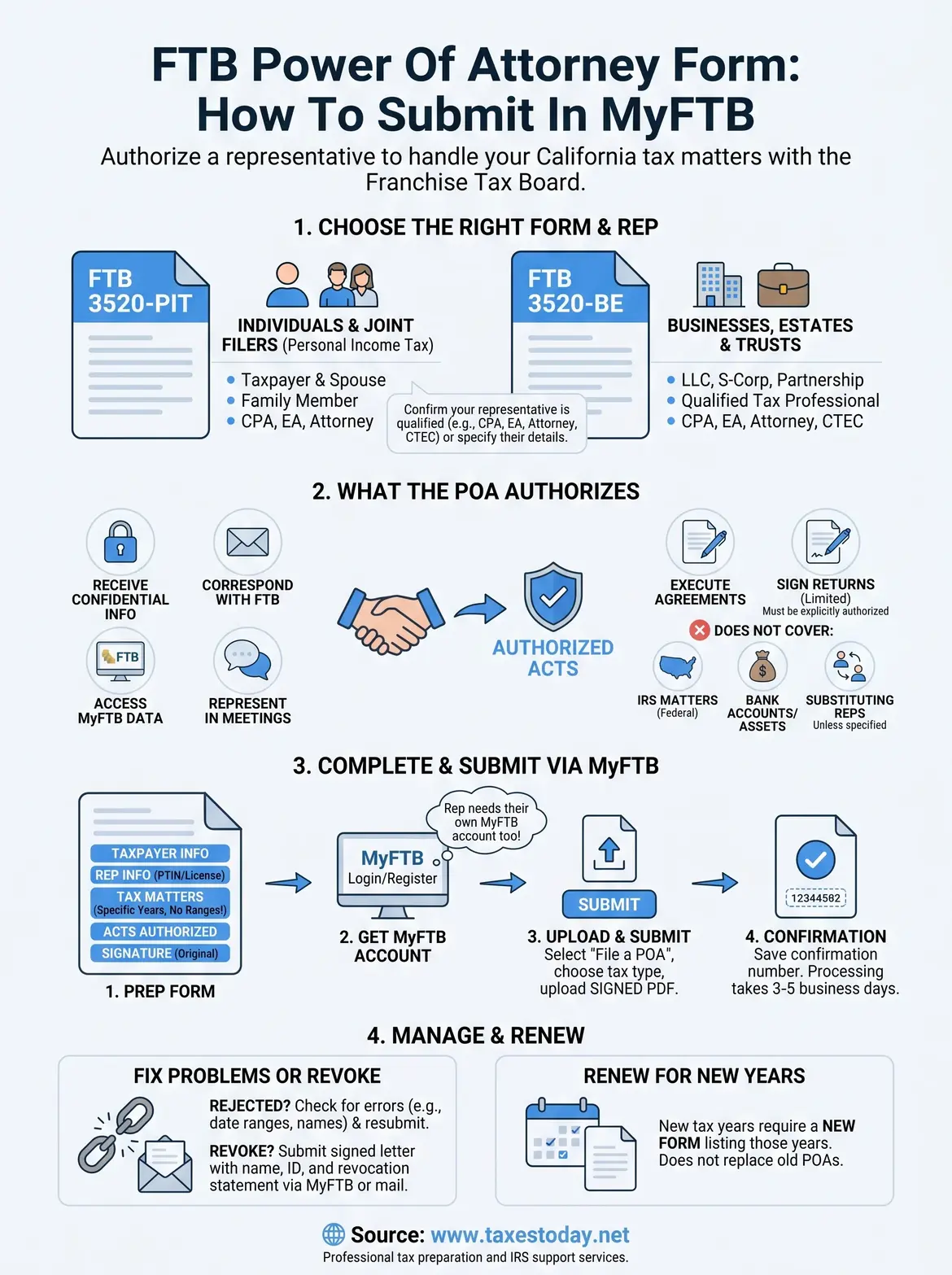
California uses two separate forms depending on your situation: FTB 3520-PIT for individuals and FTB 3520-BE for businesses, estates, and trusts. Both can be submitted electronically through the MyFTB portal or mailed directly to the FTB. Getting the form right matters, errors or missing information can delay processing and leave your representative unable to act when you need them most.
At TaxesToday, we regularly help clients across California and nationwide navigate FTB authorizations as part of our tax preparation and IRS support services. This guide walks you through each form, explains exactly how to fill them out, and covers the step-by-step process for submitting your Power of Attorney through MyFTB.
What an FTB power of attorney lets you do
An FTB power of attorney form gives another person, called your representative or agent, legal authority to act on your behalf in specific California tax matters. The FTB does not recognize informal arrangements or verbal agreements. Without a properly filed POA, even your accountant cannot discuss your account details with FTB agents, receive notices, or make changes on your behalf.
Once the FTB processes your POA, your representative can act immediately for the tax years and matter types listed on the form.
The specific actions your representative can take
Your authorized representative gains access to a defined set of actions tied directly to the tax years and matter types you specify on the form. The authorization is not a blanket permission; it only covers what you explicitly authorize.
Here is a breakdown of what your representative can do once the POA is active:
| Action | What it means |
|---|---|
| Receive confidential information | FTB can discuss your account, notices, and return details with your rep |
| Correspond with the FTB | Your rep can send and receive letters, respond to notices, and submit documents |
| Access MyFTB account data | Your rep can view your tax account information through their MyFTB account |
| Represent you in meetings | Your rep can speak on your behalf during audits, appeals, or hearings |
| Execute agreements | Your rep can sign closing agreements and settlement documents if you grant this power |
| Sign returns | Only allowed if you are unable to sign due to illness, injury, or absence, and you must explicitly authorize this |
You can also restrict what your representative can do. For example, you might authorize someone to receive information and correspond with the FTB but not allow them to sign agreements or sign returns on your behalf. This flexibility lets you match the authorization to the actual task at hand.
What the POA does not cover
The POA does not give your representative unlimited authority over your finances or legal affairs. It is limited strictly to California state tax matters administered by the Franchise Tax Board. It does not authorize anyone to act with the IRS (which requires a separate federal Form 2848), nor does it give your representative any authority over your bank accounts, assets, or other legal matters.
Your representative also cannot substitute another person in their place unless you specifically authorize delegation on the form. If your original representative becomes unavailable, you will need to file a new POA naming someone else. Additionally, the authorization only applies to the tax years you list. If you have a new issue in a future tax year, you will need to submit a new form covering that year. Keeping these limits in mind helps you authorize the right scope from the start and avoid confusion later.
Choose the right form and representative
Before you fill out anything, you need to confirm which form applies to your situation and verify that the person you want to authorize actually qualifies under FTB rules. Using the wrong form means the FTB will reject your submission, and you will have to start over.
Individual vs. business: which form applies to you
The FTB uses two distinct versions of the ftb power of attorney form, and the one you need depends entirely on who is filing the authorization.
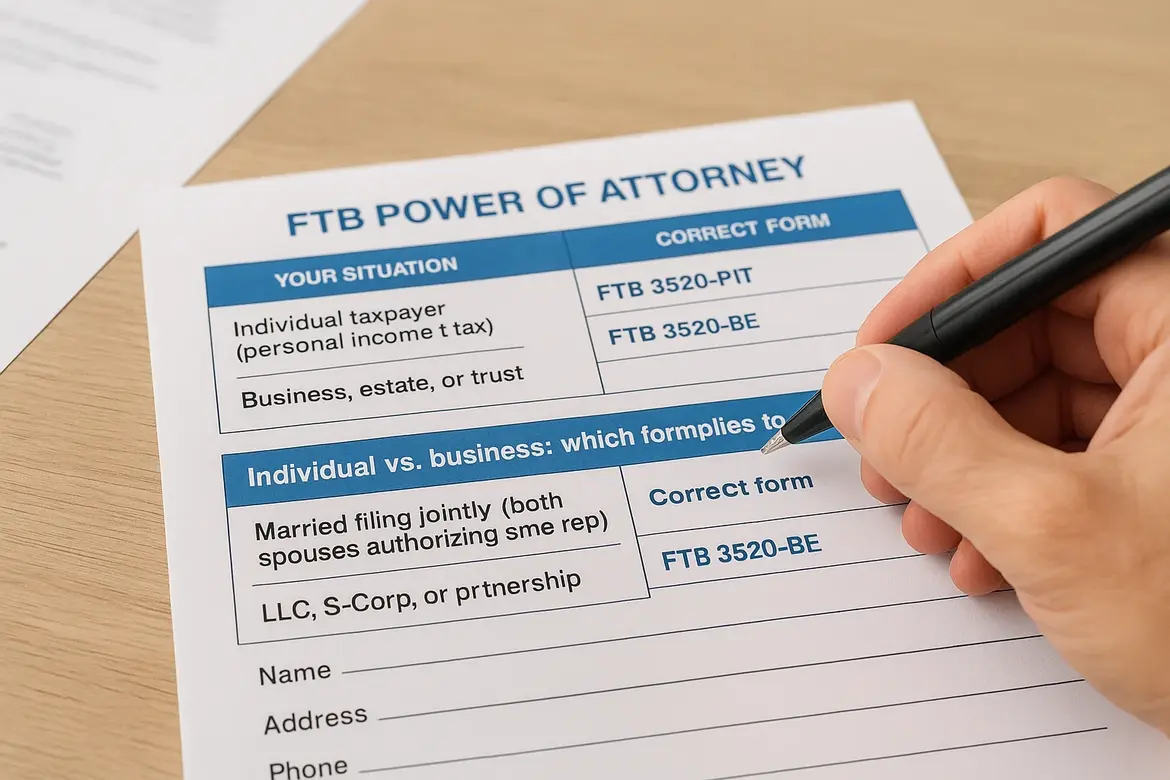
| Your situation | Correct form |
|---|---|
| Individual taxpayer (personal income tax) | FTB 3520-PIT |
| Business, estate, or trust | FTB 3520-BE |
| Married filing jointly (both spouses authorizing same rep) | FTB 3520-PIT (one form, both signatures) |
| LLC, S-Corp, or partnership | FTB 3520-BE |
If you file both a personal return and a business return, you will need to submit separate forms for each, since the FTB treats them as distinct tax accounts.
You can download both forms directly from the California Franchise Tax Board website. The PDF versions include fillable fields, so you can complete them on your computer before printing or uploading.
Who qualifies as a representative
The FTB limits who you can name as your authorized representative. Your representative does not need to be a licensed professional for all matter types, but certain actions, like representing you during an audit or signing agreements, typically require a qualified tax professional.
Acceptable representatives include attorneys, CPAs, enrolled agents, and CTEC-registered tax preparers, all of whom can handle the full scope of FTB matters. You can also authorize a family member or other individual for more limited tasks, such as receiving information or correspondence on your behalf. However, that person must be clearly identified on the form with their full legal name, contact information, and PTIN or license number if applicable. If your representative does not have a professional license, you can still name them, but leave the license field blank rather than entering incorrect information.
Fill out FTB 3520 the right way
Both versions of the ftb power of attorney form follow a similar structure, but missing or incorrect entries in any section will cause the FTB to reject or delay your submission. Before you start filling out the form, gather your Social Security Number or ITIN, your representative's full legal name, their license or PTIN number if applicable, and the specific tax years and matter types you want to authorize.
Complete each field accurately
Work through the form from top to bottom and do not skip any required fields. The table below covers the key sections and what the FTB expects in each one:
| Form section | What to enter |
|---|---|
| Taxpayer information | Your legal name, SSN or ITIN, current mailing address, and daytime phone number |
| Representative information | Full legal name, firm name if applicable, address, phone, and PTIN or CA license number |
| Tax matters authorized | Tax type (Personal Income Tax, Franchise Tax, etc.) and the specific years covered |
| Acts authorized | Check each box for the specific permissions you are granting (receiving info, signing returns, etc.) |
| Signature | Your original signature and the date; for joint filers, both spouses must sign |
If you leave the tax years field blank, the FTB will not process the form, so always list each year explicitly rather than writing "all years."
Avoid these common errors
Several mistakes consistently cause FTB to return or reject submitted forms. First, do not use ranges like "2020-2024" in the tax year field; list each year as a separate entry, for example "2020, 2021, 2022, 2023, 2024." Second, make sure the taxpayer name matches exactly what appears on your filed returns. A nickname or abbreviated name creates a mismatch in the FTB system.
Also confirm that your representative's license number is current and correctly formatted before you submit. An expired or incorrect PTIN will flag the form for manual review, which adds weeks to the processing time.
Submit the POA in MyFTB step by step
Submitting your ftb power of attorney form through MyFTB is faster than mailing it, and you get a confirmation the FTB received it. Before you start, make sure your form is fully completed, signed, and saved as a PDF on your device. The portal will not accept incomplete documents, and you cannot edit the form after uploading it.
Set up your MyFTB account access
You need an active MyFTB account before you can submit anything electronically. If you do not already have one, go to ftb.ca.gov and select "Register" under the MyFTB login area. The registration process asks for your Social Security Number, date of birth, and a recent California tax return to verify your identity. Once verified, you receive login credentials by mail or email depending on the verification method you choose.
Your representative also needs their own separate MyFTB account to access your information once the POA is processed.
If you already have a MyFTB account, log in and confirm your contact information is current before submitting. An outdated email or address can prevent you from receiving the FTB's processing confirmation.
Upload and submit the completed form
Once you are logged into MyFTB, follow these steps to submit your POA:

- Select "File a Power of Attorney" from the "Submit a POA/TIA" menu on your account dashboard.
- Choose the tax account type that matches your form, either individual or business.
- Enter your representative's information exactly as it appears on the form, including their name and PTIN or license number.
- Upload your completed and signed PDF of either FTB 3520-PIT or FTB 3520-BE.
- Review the summary screen to confirm all details match your form, then click Submit.
- Save or print the confirmation number the portal generates immediately after submission.
Processing typically takes 3 to 5 business days for electronically submitted forms. If your representative needs urgent access, call the FTB directly and reference your confirmation number to request expedited review.
Fix problems, renew, or revoke your POA
Even when you follow the instructions carefully, the FTB sometimes returns or delays a submitted ftb power of attorney form. Knowing why rejections happen and how to correct them quickly keeps your representative from losing access at a critical moment.
When the FTB rejects or delays your form
The FTB will reject your form without notifying your representative, so check your MyFTB account within a week of submission to confirm the status. If the form shows as rejected or pending review, look for one of these common causes and apply the fix listed next to it:
| Common issue | How to fix it |
|---|---|
| Tax years listed as a range | Relist each year individually, for example: 2021, 2022, 2023 |
| Name mismatch | Resubmit using the exact legal name shown on your most recent California return |
| Missing or expired PTIN | Confirm your representative's current PTIN and reenter it correctly |
| Unsigned form | Print, sign, scan, and reupload the completed PDF |
Resubmit the corrected form through MyFTB and save the new confirmation number once the portal accepts it.
How to revoke an existing POA
You can cancel your representative's authorization at any time by submitting a written revocation to the FTB. Write a signed letter that includes your name, SSN or ITIN, the representative's name, and a clear statement that you are revoking the authorization. Mail it to the address on your most recent FTB notice, or upload it through MyFTB under the document submission option. The FTB terminates the authorization once it processes your request, usually within five business days.
Renewing authorization for new tax years
A POA does not automatically carry forward to future tax years. When you have a new matter or a new tax year that needs coverage, submit a fresh form with the updated years listed. You do not need to revoke your existing POA first; the new submission simply adds the additional years to your representative's access without affecting prior authorizations already on file.
Next steps if you want help
Filing an ftb power of attorney form correctly the first time saves you from delays, rejections, and gaps in your representative's access. You now know which form to use, how to fill it out, and how to submit it through MyFTB. The key actions: pick FTB 3520-PIT for personal returns or FTB 3520-BE for business accounts, list every tax year individually, and save your confirmation number after you upload the signed PDF.
If your tax situation involves self-employment, back taxes, amended returns, or non-resident filing, having a licensed professional handle both the POA and your return reduces errors and protects you from compliance issues. Our team at TaxesToday holds CTEC certification and IRS registration, with over 15 years of experience helping individuals, freelancers, and small businesses across California and nationwide. Reach out to get professional tax preparation help and let us manage the details from start to finish.