


Average Cost of Tax Preparation for Small Business
You searched for the average cost of tax preparation for small business because you got a quote that felt either too high or suspiciously low, and you have no way to tell which. That confusion is normal. Fees swing wildly depending on who you ask and what kind of business return you're filing.
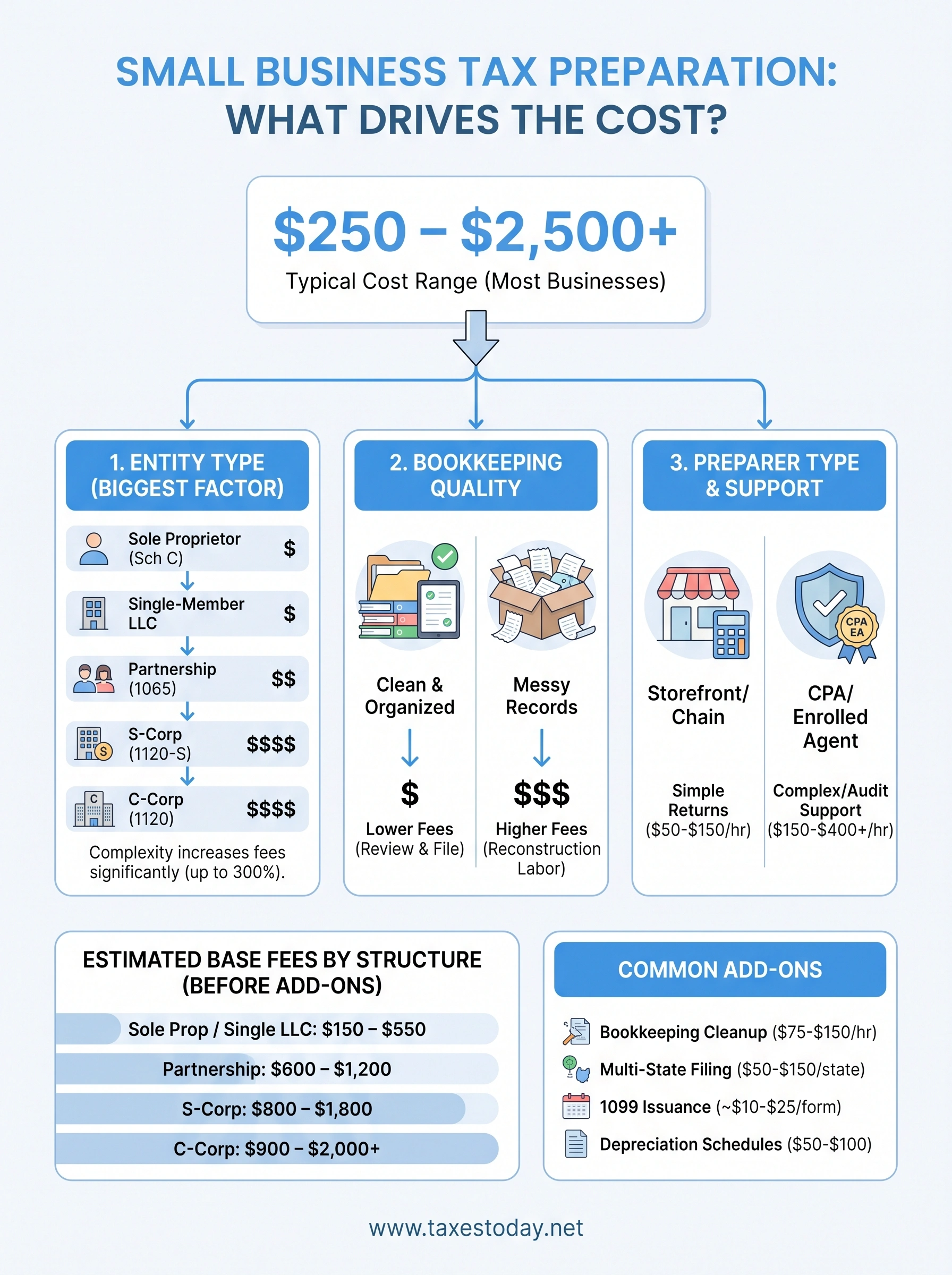
Here's the direct answer: most small businesses pay between $250 and $2,500 for professional tax preparation, with the number driven almost entirely by your entity type and how messy your books are. A sole proprietor filing a simple Schedule C pays far less than an S-Corp tax preparation cost, which usually requires a separate business return plus payroll and reasonable-compensation documentation. CPA firms typically charge more than storefront preparers, but you're paying for audit support and deeper deduction review.
Below, we break down small business tax preparation fees by structure (sole proprietorship, LLC, S-Corp, partnership, C-Corp), compare CPA pricing against other preparer types, and show what actually moves the price up or down, so you know what a fair quote looks like before you sign anything.
Why small business tax preparation costs vary so much
Ask five business owners what they paid last year for small business tax preparation services and you'll get five different answers, and none of them are lying. The cost of tax preparation for small business returns depends on a handful of variables that stack on top of each other, so two businesses with similar revenue can end up with fees that differ by hundreds of dollars. Understanding what actually drives the number helps you spot a fair quote and push back on an inflated one.
Entity type is the biggest cost driver
Your business structure determines which forms a preparer has to complete, and that alone can double or triple your bill. A sole proprietor filing Schedule C alongside a personal 1040 pays the least because everything flows into one return. An LLC taxed as a partnership needs its own Form 1065 plus K-1s for each member. An S-Corp needs Form 1120-S, a payroll reconciliation, and documentation showing the owner took reasonable compensation, which is why the average cost of tax preparation by CPA for small business S-Corps runs noticeably higher than for a single-member LLC.
Entity type alone can swing your tax preparation fee by 300% or more before anything else is even factored in.
Bookkeeping quality changes the labor involved
If your preparer receives a clean profit and loss statement with categorized transactions, they spend their time reviewing and filing. If they receive a shoebox of receipts and a bank statement, they spend hours reconstructing your books before they can even start the return, and that labor gets billed. This is the single biggest reason two businesses with identical entity types get quotes $500 apart.
Number of forms and schedules adds up fast
Every additional schedule, home office deduction, vehicle expense worksheet, depreciation schedule, or multi-state filing requirement adds line items to your invoice. A business with one owner and no employees is simpler than one with contractors requiring 1099 issuance or inventory requiring cost-of-goods-sold calculations.
Preparer type sets the baseline rate
Who you hire matters as much as what you file. CPAs and enrolled agents generally charge more per hour than storefront chains, but they also catch more deductions and provide stronger support if the IRS ever sends a notice. Chains often quote a flat fee that looks attractive until you add the schedules a small business actually needs.

| Preparer type | Typical hourly range | Best fit |
|---|---|---|
| Storefront/national chain | $50-$150 | Very simple Schedule C |
| Enrolled Agent | $100-$200 | Self-employed, moderate complexity |
| CPA firm | $150-$400+ | LLCs, S-Corps, multi-state |
How to estimate your tax preparation costs before you file
Getting a real number before tax season starts saves you from sticker shock in March. You can build a reasonable estimate yourself by gathering a few facts about your business and comparing them against published fee surveys, then confirming with a quote from an actual preparer.
Start with your entity type and prior-year return
Pull last year's return, if you filed one, and note which forms were attached. A Schedule C business form alone costs less than a return with Form 1065 or 1120-S attached. If this is your first year filing as a business, decide your entity type before you call anyone, since "how much for small business tax preparation" is really two different questions depending on whether you're a sole proprietor or an S-Corp.
Count your forms and add-ons
List out anything beyond the core return: home office deduction, vehicle mileage log, depreciation on equipment, multiple states, or 1099 issuance for contractors, and work from a list of documents to gather for a business return so nothing gets missed. Each item you check off adds to the base fee, so a realistic self-estimate should build in a cushion rather than assume the bare minimum applies.
A quote that ignores your specific forms isn't an estimate, it's a guess.
Ask preparers for a written, itemized quote
Requesting a breakdown protects you from vague flat fees that balloon once your preparer sees your books, and it helps you compare what it costs to hire a tax preparer against the credentials you're getting. Before you commit, ask for:
- Base fee for the entity return itself
- Cost per additional schedule or form
- Bookkeeping cleanup rate, if your records aren't ready
- State filing fees, if you operate in more than one state
- Amendment or IRS-notice support policy
Comparing three itemized quotes side by side, rather than three flat numbers, is the fastest way to spot who's charging fairly for your situation.
Average costs by business structure and add-on services
Numbers help more than ranges once you know where your business fits. Below is what preparers typically charge by entity type, based on national fee surveys and what we see across California filers, before any add-ons get layered on top.
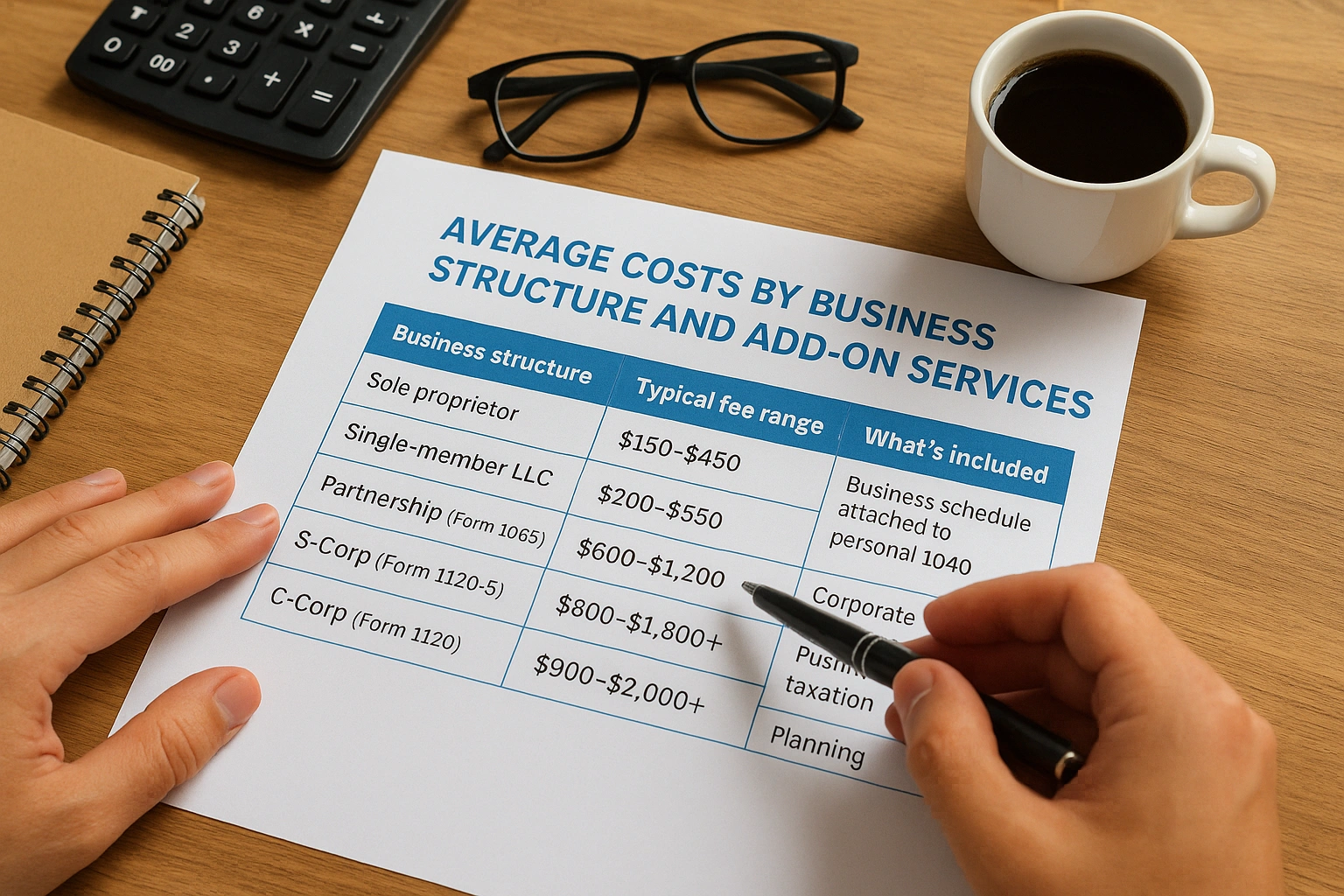
| Business structure | Typical fee range | What's included |
|---|---|---|
| Sole proprietor (Schedule C) | $150-$450 | Business schedule attached to personal 1040 |
| Single-member LLC | $200-$550 | Same as Schedule C, plus entity documentation |
| Partnership (Form 1065) | $600-$1,200 | Business return plus K-1s for each partner |
| S-Corp (Form 1120-S) | $800-$1,800 | Business return, payroll reconciliation, reasonable compensation review |
| C-Corp (Form 1120) | $900-$2,000+ | Corporate return, potential double-taxation planning |
The average cost of tax preparation for small business owners isn't one number, it's five different numbers depending on your entity.
Once you have your base structure priced, add-ons stack on top and rarely show up in a headline quote. Bookkeeping cleanup runs $75-$150 per hour when your records aren't ready. Multi-state filing adds $50-$150 per additional state. Depreciation schedules for equipment or vehicles typically add $50-$100. Issuing 1099s to contractors adds a flat fee, often $10-$25 per form. Amended returns, if you need to fix a prior filing, generally cost $150-$450 to amend a tax return on top of the original prep fee.
Gathering these figures before you shop keeps every quote honest. If a preparer's number falls well below these ranges for your entity type, ask what's excluded, because a suspiciously cheap flat fee often means bookkeeping cleanup, extra schedules, or state filings get billed separately once they discover you need them.
Getting the most value from your tax preparation fee
Paying more doesn't automatically mean you get more, and paying less doesn't mean you got a bargain. The small business tax preparation cost you settle on should reflect the deductions found and the peace of mind you get, not just the invoice total. A few habits determine whether your fee turns into savings or just an expense.
Prepare your books before you walk in
Organizing your records ahead of your appointment is the single fastest way to lower your bill. Categorize expenses, reconcile your bank statements, and total your mileage log before you hand anything over. A preparer who spends less time reconstructing your books spends more time finding deductions, and that shift alone often pays for the fee difference between a chain and a CPA.
The cheapest way to reduce your tax preparation fee for small business filing is showing up organized.
Ask what's included before you compare price
Request a plain answer to what happens if the IRS sends a notice, whether an amendment is covered, and whether next year's return gets a discount as a returning client. These answers separate a preparer who treats you as a one-time transaction from one who treats you as an ongoing relationship, and they're a big part of how to choose a tax preparation firm.
Consider a second opinion on last year's return
If you filed yourself last year or used a preparer you're unsure about, a tax return review can catch missed deductions worth more than this year's entire prep fee. It's a low-cost way to confirm you're not overpaying the IRS while you're already shopping for next year's preparer.
Budgeting for next year's tax preparation
Planning ahead turns tax prep from a March surprise into a line item you already expect. Set aside your estimated fee based on your entity type from the table above, then add a cushion for bookkeeping cleanup if your records tend to run behind. Reviewing your structure each year matters too, since a growing sole proprietorship that moves from how single-member LLC taxes work toward an S-Corp election will see its tax preparation fee for small business filing jump accordingly, and knowing that in advance beats getting blindsided by a quote.
The average cost of tax preparation for small business owners will always depend on your specific forms and books, but you now know what drives that number and what a fair quote looks like. If you're ready to stop guessing and get an actual price for your situation, get a small business tax preparation quote starting at $99 from a CTEC-certified preparer who handles Schedule C, LLC, and S-Corp returns every day.